
Legal Help For Survivors Nationwide
The high volume of searches for “Los Padrinos juvenile hall lawsuit” reflects more than just an interest in legal proceedings. It indicates that people—likely former residents or family members—are seeking deeply personal validation, asking: “Was this system unfair to me or my child, and is it possible to seek justice now?”
We can help answer your questions and connect you with an attorney if you may have a case.
This is the beginning of a series written for all survivors and their families and allies who are trying to figure out or make sense on what happened at Los Padrinos Juvenile Hall and what current legal options could they have. Our goal is very simple: to make complex systems understandable and easy to comprehend, without pressure, with the survivors’ on our mind.
You don’t have to read the entire article in one go, you can move at your own pace and revisit sections. We’ll break down the topics so that it is easy enough to follow.
If you were detained at Los Padrinos as a child or teenager and experienced sexual abuse, physical violence, threats, or other harm, these guides are meant to give you information—not to tell you what you “must” do. You are the expert on your own life and your own healing.
It is usually the loved ones who are putting the pieces together whenever a suspicion arises. More often than not, the survivors are not always ready to share. We’ll help you understand the system and the potential legal options that you may have, so you will be ready whenever the survivor decides to talk.
Survivors often look for people who work in the education field, social work, faith communities, or grassroots organizations when they want to talk to someone about their experience. Having basic knowledge about Los Padrinos can help you when the time comes. You can then listen with confidence and connect them to the right people or trauma-informed legal resources.
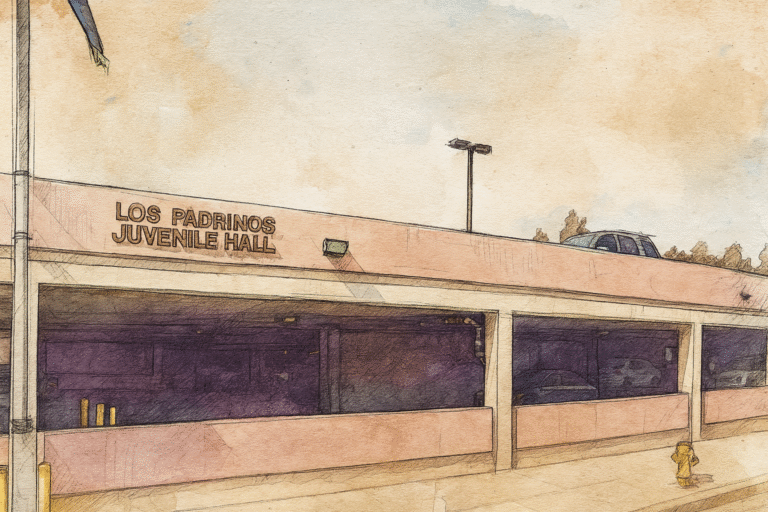
Los Padrinos Juvenile Hall is a youth detention facility in Los Angeles County. For years, it has been one of the places where young people were held while their cases moved through the juvenile justice system.
Los Padrinos has housed:
The facility promised that they would provide secure care and rehabilitation. But if you ask anyone who were actually there, they would tell you otherwise. It was nothing like that. They would even describe it as living in constant fear.
Los Padrinos is part of a bigger network of juvenile halls and camps that is run by Los Angeles County. When a juvenile is held, its duration and types of services that they’d get would be determined by the following:
The entire system is reflected when abuse is allowed to happen in one of its facility. Staffing, oversight, culture and accountability are the most common problems.
Many families were told that juvenile detention was meant to help their child. You’ll often hear them say or promise that they’d get them on the right track.
More promises:
Unfortunately, there are instances where the reality is far from the promised. Survivors felt and experienced unsafe units, staff who looked the other way, and a culture where abuse could certainly flourish. This gap between what was promised and what actually happened is a core reason lawsuits are now being filed.
Los Padrinos has been known to be a source of repeated concerns, complaints, and public reports. Though each case reported were unique, certain patterns have been seen to appear repeatedly.
These were the things that the survivors described:
Sexual abuse while in a detention center is not just a “boundary violation,” it is a violation of basic human rights and can leave deep physical and emotional scars.
Some survivors report that violence wasn’t just tolerated—it was encouraged or orchestrated. This can include:
Staff members that allow violent situations cannot say that they are just “losing control”, this is a clear abuse of power.
Abuse is not only what is done to a person, but also what is deliberately withheld.
Survivors have described:
Experiences like these are just as bad as experiencing physical assaults or even worse. This adds more trauma to young people.
Many of the same issues show up across Los Angeles County’s juvenile halls and camps. This suggests that the problem is not one “bad apple” officer, but a system that failed to protect the children in its care. Lawsuits are one way survivors and families are challenging that system.
For years, many survivors stayed silent for very understandable reasons:
More and more people who suffered begin to realize that they were not alone. This is thanks for other survivors sharing their stories to journalists, advocates and for some, attorneys. As more survivors come forward and tell their stories, this helped expose long-stading patterns of abuse.
Criminal charges and disciplinary actions have been brought against some staff members, following investigations launched by government agencies in response to reports and public pressure. These actions matter, but they will never erase the harm survivors suffered. Civil lawsuits are one way survivors seek compensation and push institutions to change policies.
Many survivors and families are clear: reforms on paper are not enough.
Here are what lawsuits can do:
For some survivors, a lawsuit is less about money and more about being believed, being heard, and making it harder for the same harms to continue.
We will explain, in plain language, who might have a legal claim based on:
You will learn the difference between:
We’ll walk through how civil lawsuits, government claims, and other legal tools work, and how they may look in real life—not just in legal textbooks.
Most importantly, we will keep coming back to you: your safety, your emotional well-being, and your right to move at your own pace. Legal action is one path among many. It should support your healing, not overshadow it.
You are not required to take any legal step just because you are learning about your options.
Your role is to be a steady, trustworthy presence.
You’ve carried this long enough. Let us help you carry it from here. Call for a private consultation or submit your information securely online.